
What is print on demand and how does it work?
On-demand printing explained simply: the path of an order, the path of the money, the real advantages, and the limits even the suppliers write down.
In a workshop at night, a t-shirt drawn in dotted lines floats above a small press waiting for the order.
MagicMoon · EditorialThe short version
- Print on demand, or on-demand printing: you sell a custom product that is only made after the order, by a supplier who ships it under your name.
- Your customer pays you; the supplier charges you for production and shipping. The difference, before your sales platform’s fees, is your margin.
- No inventory, almost nothing to pay upfront. In exchange: a thinner margin, longer delivery times, and customer service is on you.
- It is a form of dropshipping, with one big difference: the product carries your design.
- Signing up is free at Printify, Printful and Gelato. Still, count the samples and your platform’s fees.
What is print on demand (POD)? My answer in one sentence
What is print on demand? Here is my answer in one sentence: you sell a product that does not exist yet. A t-shirt, a mug, a poster, with your design on it. It is only made when a customer buys it, by a supplier who prints it, packs it and ships it for you.
You will also see it called on-demand printing, or POD for short. All of these mean the same thing: a business model with no inventory, where production follows the sale instead of coming before it.
And I am not making this up. The three big suppliers I write about on this blog each put it in their own words. For once, they agree.
A quick clarification before going further: the same term also means printing books one copy at a time. Type “print on demand” into Google and it suggests “books”. Here, I am talking about products: t-shirts, sweatshirts, mugs, posters, phone cases, tote bags and the like.
| Supplier | Its definition |
|---|---|
| Printify | A process that ships products directly to customers, only once the sale goes through |
| Printful | A model where the provider manufactures a product only after the customer orders, then ships it to that customer under your brand |
| Gelato | A model where products are created only after a customer places an order |
Who pays whom? The money in two transactions
This is the question everyone has without daring to ask it. And Printful answers it most clearly: every order involves two separate transactions.
One: your customer pays you, directly, the retail price, on your store or on the marketplace. Two: the supplier charges you for the product, shipping and taxes when the order reaches it. The difference between the two is your margin, before your sales platform’s fees.
Note this detail: the supplier does not see your customer’s money. Printful says so for its orders, outside its own turnkey stores, which are a separate case. The direct consequence: if a customer needs a refund, you are the one who refunds them. Even when the supplier refunds you for a defective item, refunding your customer remains a separate step, on your store.
And how does the supplier make a living? On what it makes. Printify writes it: it earns its margin on the product price you pay it with each order, with no platform fees. At Printful and Gelato too, signing up is free, and you pay when an order comes in. On top of that, each offers optional paid plans. More on that below.
| Who pays | Whom | What | When |
|---|---|---|---|
| Your customer | You | The retail price, plus shipping and taxes | At purchase |
| You | The supplier | The product, the printing, shipping and taxes | When the order reaches it |
| You | The sales platform | Its fees, under its terms | Depending on the platform |
| What you keep | You | The difference: your margin | After each sale |
What you do, and what you never do
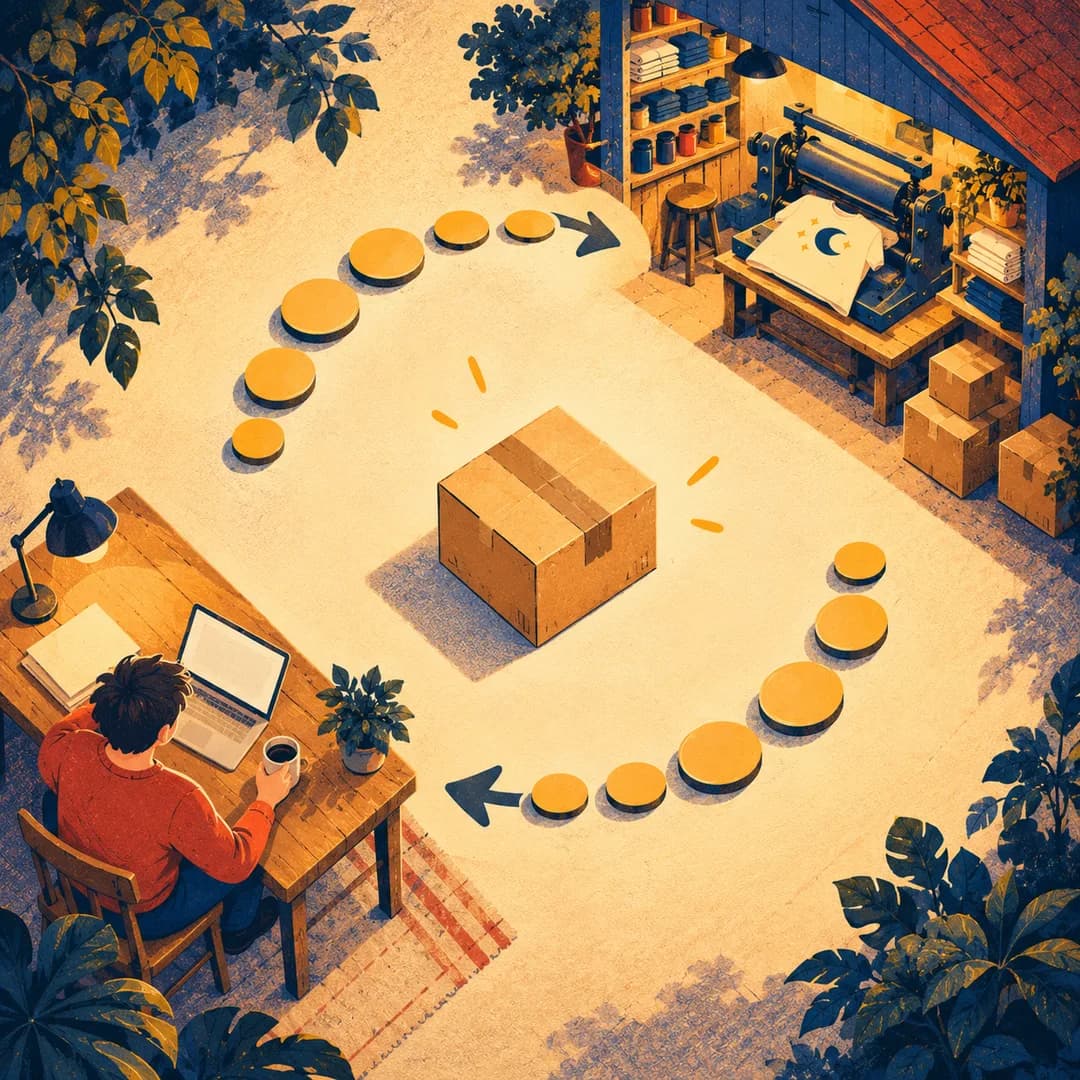
People often sum up print on demand as “the supplier does everything”. That is wrong. It does everything physical. Everything else is you.
And that “everything else” is exactly what makes sales: the idea, the design, the product listing, the price, the promotion. Plus one task people always forget: customer service. The customer bought from you; you are the one they write to when their package is late.
That is why I am wary of the word “passive”. The supplier’s machines run on their own. Your ideas do not.
| You | The supplier |
|---|---|
| Find the idea and create the design | Supply the blank product |
| Choose the products and set the prices | Print, or embroider |
| Write the listings and publish | Pack |
| Promote your store | Ship |
| Answer customers, refund them if needed | Reprint a defective item reported within 30 days, or refund you for it |
Which custom products, and which printing techniques?
The t-shirt is still king. Printful even calls it the backbone of print on demand. But the catalogs go well beyond it: sweatshirts, caps, socks, bags, phone cases, mugs, stickers, posters, canvases… Printify advertises more than 2,000 products; Printful and Gelato offer several hundred.
Behind each product, a technique. No need to memorize them all, but knowing which one applies will save you some surprises: an uneven gradient on a t-shirt, sublimation that cannot work on cotton.
One technique stands apart: screen printing. It is made for large runs, and Printful admits it: it is not the most cost-effective option for one-off pieces. Some services offer it, but for large quantities.
| Technique | How it works | What it is for |
|---|---|---|
| DTG, direct-to-garment | The ink is sprayed directly onto the fabric | Full-color visuals on cotton |
| DTF, direct-to-film | The design is printed on a film, then heat-pressed | Fine details, on cotton, polyester or fleece |
| Sublimation | Heat makes the ink penetrate the material | Polyester and coated items, like mugs |
| All-over print | The garment is printed edge to edge | Patterns that cover everything |
| Embroidery | The design is stitched with thread | Logos and text, on caps and jackets |

The real advantages of print on demand
Enough mechanics. Why is this model so appealing? Here is what holds up, with evidence.
- No inventory to buy. Each product is made after the sale. No boxes in the garage, no unsold stock.
- Almost nothing to pay upfront. Printify sums it up: aside from optional samples and small marketplace fees, there is nothing to invest at the start.
- Testing an idea costs almost nothing. A design does not sell? You move on to the next one. Nobody leaves you with a hundred t-shirts on your hands.
- Hundreds of products to offer, more than 2,000 at Printify, without buying anything in advance.
- Production close to your customers. Printify advertises more than 140 print facilities, in the United States, Canada, the European Union, the United Kingdom, Australia and China; Gelato, local production in 32 countries.
- Time for what matters: design and promotion, not logistics.
My take: I do not know any other business where one person, with a very small budget, can open a store and test several ideas without risking their savings. That is no small thing.
The limits, which even the suppliers write down
Now, the flip side. And I will let someone well placed speak: Printful itself. In its own guide to print on demand, it lists the model’s drawbacks. A supplier writing down the downsides of its own trade? Hats off. 🙂
- A slightly thinner margin. Making one item at a time costs more than making in bulk. You pay for flexibility.
- Longer delivery times. The product is made after the order: production time comes on top of shipping time.
- Less control over packaging. The supplier chooses the box or the mailer.
- A catalog you do not choose. You sell what your supplier can make, nothing else.
I will add three points, taken from their own pages. Printify acknowledges that quality and shipping times can vary from one print provider to another. Neither Printify nor Printful replaces or refunds an item ordered in the wrong size or the wrong color: a manufacturing defect, yes; a customer’s mistake, no. And as you saw above: customer service is on you.
Nothing that rules it out. But better to know it before a customer reminds you.
| The advantage | Its flip side |
|---|---|
| No inventory | A higher unit cost than in bulk |
| Made to order | Production time before shipping |
| The supplier packs and ships | You do not always choose the packaging |
| A network of print providers, at Printify | Quality that can vary from one print provider to another, as Printify writes |
| No logistics to handle | But customers to serve |

How long does delivery take?
The question that annoys customers in a hurry. In print on demand, delivery time is a sum: production time, plus shipping time. Printful puts it very simply: to know when an order will arrive, add one to the other.
On production, Printful advertises 2 to 5 business days on average. Printify says most of its orders ship within 2 to 7 business days. On shipping, Printify counts 2 to 3 business days for local delivery with most of its print providers, and usually 10 to 30 days for international shipping.
My rule: have your products made close to your customers. A French customer served by a European workshop will wait far less than one served from the other side of the world. And state honest delivery times on your listings. A customer who has been warned is a patient customer.
| What the suppliers advertise | |
|---|---|
| Production, at Printful | 2 to 5 business days on average; more than 97% of orders shipped within 5 business days |
| Production, at Printify | Most orders shipped within 2 to 7 business days |
| Local shipping, according to Printify | 2 to 3 business days with most of its print providers |
| International shipping, according to Printify | 10 to 30 days, usually |
Starting a print on demand business: how much does it cost?
Good news: signing up is free with the three suppliers I write about. Printful says it plainly: no setup fees, no order minimums, no required subscription. Gelato too: free sign-up, and you only pay for what you sell. Production is only paid for when an order comes in.
But “free to start” does not mean “free”. There are still expenses, small but real.
- Samples, to hold your product in your hands before selling it. Essential, in my opinion.
- Your sales platform’s fees, under its terms: marketplace or your own store, each has its own.
- The suppliers’ paid plans, optional: a subscription in exchange for lower production prices.
- Advertising, if you choose to run any.
The details, step by step, are in my guide to starting print on demand.
| Free? | |
|---|---|
| Signing up at Printify, Printful or Gelato | Yes |
| Creating your products at the supplier | Yes |
| Producing each order | No: paid per order, with shipping and taxes |
| Samples | No: paid like an order; 20% off at Printful, if your store is connected |
| Paid plans | Optional: Premium at Printify, $39 a month, or $24.99 a month billed yearly; Growth at Printful, $24.99 a month |
Print on demand vs dropshipping: what is the difference?
Google asks the question for you: “is print on demand the same as dropshipping?”
The short answer: it is a form of it. Printify itself describes it as a process that ships products directly to customers, and its page is titled “Print on Demand & DropShipping Platform”. In both cases, you sell without inventory, and someone else ships.
The difference lies elsewhere. In classic dropshipping, you resell a product that already exists, as a supplier offers it to anyone who wants to sell it. In print on demand, the product is made for you, with your design. Your advantage is that design. That is also why POD suits creators so well.
| Classic dropshipping | Print on demand | |
|---|---|---|
| The product | Already exists, as is | Made after the order |
| What you bring | The choice of product | The design |
| Your inventory | None | None |
| Who ships | The supplier | The supplier |
Where to sell print on demand products?
The supplier makes the products, but it does not sell them for you. You need a storefront, and there are two main kinds.
Marketplaces, like Etsy, Amazon or eBay: the customers are already there, and you benefit from their traffic in exchange for their rules and their fees. Your own store, on Shopify, WooCommerce or Wix: more freedom, but bringing in visitors is up to you.
Suppliers connect to most of them. Printify lists Shopify, Etsy, WooCommerce, eBay, Wix, PrestaShop, BigCommerce and Amazon; Gelato, Shopify, Etsy, WooCommerce, TikTok Shop, Amazon, Wix, Squarespace and BigCommerce. Once connected, orders flow from your store to the supplier on their own.
One thing to watch for print on demand on Etsy: Etsy requires you to list your production partner, meaning the supplier that makes your items. At Printful, this is not automatic: do it on your listings. And to know which door to start with, it is in the same guide to getting started: just one at first, not three.
| Marketplace | Your own store | |
|---|---|---|
| Examples | Etsy, Amazon, eBay | Shopify, WooCommerce, Wix |
| Visitors | Already there | Up to you to bring them in |
| Rules | The marketplace’s | Yours |
| Fees | The marketplace’s | Those of your platform and your payment service |
Frequently asked questions about print on demand
The questions that keep coming up around print on demand, several of them suggested by Google, and my answers in two sentences.
What is print on demand, in one sentence?
It is selling custom products that are only made after the order, by a supplier who prints them and ships them to your customer, under your name.
Can you sell t-shirts online without inventory?
Yes, that is the whole idea: you have no inventory. The supplier makes each t-shirt to order, from its blank products.
Is print on demand free?
Signing up at Printify, Printful or Gelato is free, and you only pay for production when an order comes in. Still, count the samples and your sales platform’s fees.
Do you need to know how to draw?
No. Suppliers have free editors to place text or an image; you can also hand your designs to a graphic designer, or generate them with AI, which is what MagicMoon does.
Who handles customer service?
You, as a general rule. The customer paid you: you are the one who answers them and refunds them if needed; the supplier, for its part, reprints a defective item reported within 30 days or refunds you for it.
Which print on demand supplier should you choose in France?
Printify has print providers in Europe, including France, Printful has its workshops in Riga and Barcelona, and Gelato produces in 32 countries. The right choice depends on your products and your customers: I compare all three in my Printify, Printful or Gelato comparison.
Is print on demand a scam?
The model, no: it is the very business of Printify, Printful and Gelato, and you only pay when an order comes in. Be wary instead of the promises of passive income and easy money that get attached to it.
What now? My take, and MagicMoon
So, is print on demand right for you?
- Yes, if you have ideas, the urge to create and the patience to test. The model lets you try with almost no risk.
- Yes, if you already have an audience, a community, a world of your own: it is the simplest way to offer them products.
- No, if you are looking for effortless income. The supplier makes the products; nobody sells them for you.
- No, if you are aiming for the lowest prices on everyday products: one item at a time, you will not beat bulk production.
If the answer is yes, the logical next step is my guide to starting print on demand: the niche, the first designs, the first sale. And to choose your supplier, I compared Printify, Printful and Gelato, then Printify and Printful in detail.
One last aside. MagicMoon sits just before the supplier: the creation. You describe your designs there, the AI generates them with a transparent background, and you place them on Printify or Gelato products. Publishing then goes to your Shopify, Etsy or WooCommerce store, through your supplier.
The account is free and requires no credit card: it lets you discover the workflow in demo mode. To generate your designs for real, you choose a plan or a one-time top-up.

How on-demand printing works, order by order
Let’s take an example. You have drawn a cat reading the newspaper over a cup of coffee, and you want to sell it on custom t-shirts. Here is what happens, in order.
Notice something? At no point do you touch the t-shirt. You did not buy it beforehand, you did not store it, you did not go to the post office. Printify sums it up this way: when a customer orders, the print provider produces it, packs it and ships it, automatically.
And the name on the package? Yours. This is what is called white label: the supplier works behind the scenes. Printful says it in so many words, your customers only see your brand. Printify states that its name appears nowhere on the package or the shipping label. With one honest caveat: at Printify, some print providers do not print your store name on the shipping label; at Printful, partner facilities do not include your custom packing slip or your custom packaging.
A word on “no inventory”, to be precise. You are the one with no inventory. The supplier, for its part, has blank t-shirts on its shelves. In fact, when one runs out, Printify lists that among the causes of delay.